

Ask the Pro Archive - 2010
|
Here are all the golf questions and answers that appeared on the "Ask the Pro" page in 2010, from most recent to least recent, top to bottom. Links in the left menu column give a "keyword" indication
of the topic and will take you directly to that entry on this page. Also see the Ask the Pro Archive Index for longer descriptions in categorized and somewhat alphabetized form.
|
 Golf Questions and Answers (2010)
   |
  |
Question:
December 22, 2010
Why is hitting golf balls on the practice range different than hitting balls when you are actual playing?
Vito Fortuna
Naples, FL
Answer:
Hi Vito,
It is different for many reasons. Among them, is the difference in shot rhythm (on the range you choose when to make the next swing, on the course you mostly wait a long time between shots), which club you use (on the range you usually hit the same club may times in a row, on the course you usually hit a different club on each successive shot), and psychological effects (e.g., shots on the course seem more important than shots on the range).
You can see that the two experiences are completely different. To take your skills from the practice facilities to the course and have them be equally effective you have to have solid technique and well-ingrained habits.
Note added 2013: Also see Dealing with Nervousness on the Golf Course and Mental Game Resources.
Technique is covered in detail in my golf instruction books, The Full Swing, The Short Game, Beyond the Basics and Hitting it Longer. Thanks for visiting PGAProfessional.com and best of luck with your game. MB
Equipment > Graphite-Hybrid confusion
Question:
December 3, 2010
What is the difference between hybrid and graphite golf clubs?
Leslie Silvia
Fall River, MA
Answer:
Hi Leslie,
It can be confusing but let's simplify it first. Graphite is usually a shaft material. Hybrids are usually considered clubs that function as a blend of irons and fairway woods. If you just keep it at that level it's pretty straight forward.
However, of course, it can't really be that simple. There are golf clubs with heads made of graphite, or a combination of materials that might include graphite, and some people or manufacturers might refer to this combination of materials as "hybrid." That confuses the issue a bit, doesn't it? As if that's not enough, there are also some shafts that combine materials (e.g., steel and graphite) and some people or manufacturers might refer to this as a hybrid shaft.
I'm not sure what level your question is coming from but perhaps that helps to confuse things further.Thanks for visiting PGAProfessional.com and best of luck with your game. MB
Miscellaneous > Terminology - Words and Phrases > Pluralization, hyphenation of "hole in one"
Question:
November 22, 2010
What is the plural of hole in one? And, is hole in one, or the plural, hyphenated?
Don Staruk
Newburyport, MA
Answer:
Hi Don,
I'd go with "aces."
If you want to stick with hole in one it sounds pretty awkward either way. Supposedly the thing that is subject to the change in number is pluralized. So, as I think most people would agree, it is the holes that are changing in number. Therefore, "holes in one" is probably correct and I'm going to go with that unless I hear differently from somebody who knows better.*
But, to play devil's advocate, what if you considered a hole in one to be "a thing" -- like aces are things. If that were the case wouldn't it be hole in ones? Maybe it's one of those many words or phrases that have variants that are all acceptable.
Regarding the hyphenation, I have seen it both ways but without the hyphen (hole in one) is most common, and that is how I found it in the dictionary. Thanks for visiting PGAProfessional.com and best of luck with your game. MB
* If we have any English professors or experts reading this that have more authoritative information in this area please feel free to .
Note: Don sent in this question while writing the obituary for his father, Walter E. Staruk, who passed away on October 17, 2010. Here's a brief excerpt "...an accomplished golfer, he scored eight holes in one, shot his age 254 times from age 71 to age 82..."
Rules, Etiquette and Procedures > A swing, a miss, a hole-out and the score
Question:
November 10, 2010
My wife swung at the ball on the tee box and missed. She swung a second time and it went in the hole (par 3) is this a hole in one?
Eugene Jeanson
Brownsville, TX
Answer:
Hi Eugene,
No, it's a birdie (the first stroke counts). But talk about covering the full spectrum of possible performance in the shortest time... wow! All the way from a whiff to a hole-out from one swing to the next. Go figure. Thanks for visiting PGAProfessional.com and best of luck with your game. MB
That reminds me of something that happened to me one time (not the whiff part
If any of you have a really weird birdie or lower in your history that seems like a worthy tale to tell .
Long Game > General > Grips - neutral, strong and weak
|
|
Question:
October 25, 2010
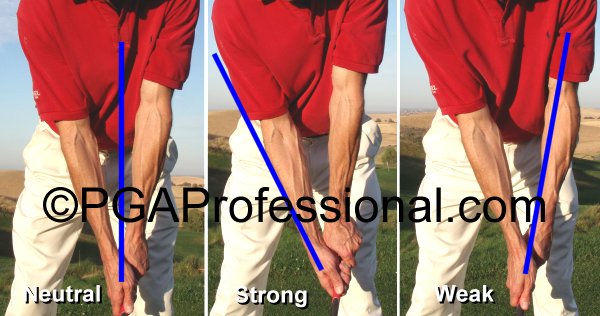
What [does] a strong and a weak grip look like?
Thom Angele
Loveland, OH
Answer:
Hi Thom,
In the photo below you'll see that whether a grip is strong, weak or neutral can be determined by where the line or "V" between the thumb and forefinger of either hand point (as clarified by the blue lines). In the photo the bottom hand is visible and the top hand is covered up, but you can see that the back of the top hand is more, or less, visible depending on the strength or weakness of the grip.
Details of the grip are covered in my book The Full Swing. Thanks for visiting PGAProfessional.com and best of luck with your game. MB
Equipment > The effect of lie angle
Question:
October 10, 2010
I'm looking at a set of clubs with a 2 degree lie. What does a 2 degree lie do to the performance of the club?
Al Ashworth
Surfside Beach, SC
Answer:
Hi Al,
Properly fitted lie angle can vary from one player to the next. The lie angle of clubs can be too upright, too flat, or just right for any given player. If you have received a fitting and been advised that you need a 2 degree adjustment be sure you know which way.
All else being equal, if your lie angle was too upright for you it would tend to contribute to pulling shots (to the left for a right-handed player). So, of course, the opposite is also true: if your lie angle was too flat for you it would tend to contribute to pushing shots.
Get with a local club fitting professional to have your lie angles and many other club specs made correctly, or adjusted for you. Thanks for visiting PGAProfessional.com and best of luck with your game. MB
Miscellaneous > Professional Golf-related > How the Ryder Cup Captain is chosen
Question:
September 28, 2010
How is the Ryder Cup Captain picked?
Tim Hughes
Ponte Vedra Beach, FL
Answer:
Hi Tim,
As I understand it, a group from the officers and board of directors of the PGA select a player who (usually but not necessarily always) is in his late forties, has a good relationship with the current players on the tour, is NOT on the Champions Tour, has won a major and has Ryder Cup experience. Thanks for visiting PGAProfessional.com and best of luck with your game. MB
Equipment > Temperature, humidity, altitude: Does the ball go farther on hot humid days?
Question:
September 1, 2010
Does a golf ball travel farther on hot humid days?
Steve James
Wentzville, MO
Answer:
Hi Steve,
Yes, the ball typically goes farther in hotter temperatures, in higher humidity and at higher altitudes. There may be some formula for calculating it all (not that you could actually make any practical use of it in any real world golf situation), but learning how much to adjust for various conditions is part of what you learn from experience playing the game. Thanks for visiting PGAProfessional.com and best of luck with your game. MB
Equipment > Which ball to play
|
|
Question:
August 15, 2010
I'm a young golfer with a slower swing speed[.] What kind of balls should I be lookin[g] for?
Aric Wren
Covington, Kentucky
Answer:
Hi Aric,
Which ball any golfer plays is a matter of personal preference. At earlier stages in the development of your golf game you may not have enough experience to even have any personal preferences yet; so which ball you are playing at that point is certainly not the weak link in your game and, therefore, really does not make any difference. The same goes for higher handicappers.
By the time you have gained enough experience, and/or have achieved a high enough skill level, for it to make a difference you will know which ball(s) you prefer. In the meantime, read what the manufacturers have to say about their various balls and experiment by trying many types. Also see 2 or 3 piece ball from the "Ask the Pro" archive.
To repeat myself, I suggest that golfers look for improvement in their golf games by working first on their understanding, technique, feel and gaining experience. Then equipment will fall into place in the natural course of things.
Technique is covered in detail in my "Your Golf books." Thanks for visiting PGAProfessional.com and best of luck with your game. MB
Long Game > General > "Cupping" the left hand, and preventing a hook
Question:
August 14, 2010
What is coupling the left hand? [The] announcer said it would prevent you from hooking.
James Toon
Fayetteville, TN
Answer:
Hi James,
That's "cupping" - see cupping - in my golf glossary. That, alone, won't prevent a hook, though it might make it more difficult. Cupping is actually one relatively common factor in slicing. For hooking see this FAQ. Thanks for visiting PGAProfessional.com and best of luck with your game. MB
Miscellaneous > Terminology - Words and Phrases > "High side - low side", "above - below"
Question:
July 20, 2010
When putting, is there a term top of the hole or bottom of the hole? If so, please explain.
Jerry Gauthier
Athelstane, Wisconsin
Answer:
Hi Jerry,
Since the putting surface is rarely perfectly level, the words or phrases commonly used to describe what you are talking about are "high side" and "low side", or "above" and "below" the hole. Though I haven't heard the words "top" or "bottom" used very frequently in this context they are also reasonable (top or bottom edge is sometimes used). Thanks for visiting PGAProfessional.com and best of luck with your game. MB
Long Game > General > Temperature: Shorter distance in cold weather
Question:
July 11, 2010
Does the ball travel slower in cold weather?
Fiona MacKinnon
Glasgow, Scotland
Answer:
Hi Fiona,
Yes, balls do go somewhat (usually a little) farther in hotter temperatures, higher humidity and higher altitude and, therefore, shorter in opposite conditions. But your distance at colder temperatures may have as much (or more) to do with your muscles firing more slowly when they're colder as it does with ball performance. How much to adjust in any given situation is one of the things you learn from experience. Thanks for visiting PGAProfessional.com and best of luck with your game. MB
Equipment > Who needs a 2 degree hook face?
|
|
Question:
June 20, 2010
What type of golfer would need a driver with a 2 degree hook face?
Terry Donovan
McHenry, IL
Answer:
Hi Terry,
Well, "need" is debatable. But very generally the type of player that would be recommended to a driver with a 2 degree hook face (a club deliberately made with a closed face, as opposed to square or open) would be somebody who had a slicing problem to one degree or another. It is also possible that a golfer might have a personal preference for the look, feel or performance of a driver with a closed face, which might not be related to a performance problem at all.
I would always recommend approaching a technique issue by working on your technique, rather than trying to correct it with equipment. By developing your understanding, skill and feel proper equipment becomes refinement rather than being remedial.
Technique is covered in detail in my books "The Full Swing" and "Hitting it Longer." Thanks for visiting PGAProfessional.com and best of luck with your game. MB
Equipment > To use, or not to use, a "chipper" club
Question:
June 15, 2010
I use a chipper club and it takes a lot of strokes off my game. My daughter is taking lessons and the golf pro doesn't want her using a chipper. You don't see pros on TV using a chipper, how come when they are such an easy club to hit? Should I allow my daughter to use a chipper or not?
William Berry
Gaylord, MI
Answer:
Hi William,
Though you may have gotten used to the club over time and, therefore, have developed a feel for it, it's not a very versatile club because you can't really play any other shots with it. An iron, on the other hand, can also perform many other shots in addition to playing chip shots effectively.
Those chippers are basically just like 7 irons with very shallow faces and putter grips, for the most part (and, in fact, some of them are not allowed within the rules -- see this previous post on chippers). So I would recommend using an iron (6 or 7 iron is a common choice for the low running chip shots) instead of a chipper. Thanks for visiting PGAProfessional.com and best of luck with your game. MB
Rules, Etiquette and Procedures > Should golfers invite themselves to play with others golfers
Question:
May 30, 2010
Should golfers invite themselves to play with others golfers when they are ready to tee off? There are times my family would like to play alone. What if you are discussing business or personal private matters while playing golf? I think it is rude to invite you[r]self to join others golfers. Maybe you just do not like the golfer that is inviting the[m]self. What is the best way to handle this?
S. Olson
Rocky Face, GA
Answer:
It's pretty common practice for golfers to ask to join groups of less than four. But if you prefer to play alone (or just with your group) simply let the person asking know and, if you feel so inclined, you could also offer to let them go ahead of you if there are more of you than there are of them. Thanks for visiting PGAProfessional.com and best of luck with your game. MB
Equipment > Shaft butt diameters, grip core diameters, .580, .600
Question:
May 10, 2010
Why do golf club manufacturers fit grips .580 on .600 butt shafts?
Brin Leah
London, U.K.
Answer:
Hi Brin,
Maybe it's just convenience, or economics, or maybe they figure the average person's hands are getting slightly larger. Club fitting and repair is not really "my thing," but let's clarify some of the basics here. The numbers .580 or .600, etc., are diameters, in inches, either of the butt end of shafts or the inside of grips. These sizes can vary between different types of shafts and grips.
In the olden days
I'm a proponent of putting your time and energy into understanding, technique, feel and experience rather than looking to equipment for improvement (I'm almost positive that my grip sizes do not match completely throughout my set). But having equipment that you like, and that fits you properly, is a good idea. Thanks for visiting PGAProfessional.com and best of luck with your game. MB
Long Game > General > Problem being laid off at the top
|
|
Question:
April 20, 2010
I have a friend [who] is a good golfer, 1 or 2 handicap. He is in a huge slump. I noticed at the top of his swing the club is pointed way left of the target. [I'm] not sure what this is called but he can't seem to fix it. The practice swing looks fine. I have played with him for years so I know this is new to his swing. Any tips to cure this? With this move his shots go right and left. Please help. Thanks.
George Sakadales
Port Charlotte, Florida
Answer:
Hi George,
If he is right-handed what you are describing is called "laid off" (see laid off in my Golf Glossary). From that position the chances increase of active use of the hands with associated (and possibly wide) variation in club face position at impact. The general solution is to achieve a better position at the top of the backswing so the club can be allowed to release more freely. But there might be endless details involved in what he is doing.
Technique is covered in detail in my books "The Full Swing" and "Hitting it Longer." Thanks for visiting PGAProfessional.com and best of luck with your game. MB
Miscellaneous > Professional Golf-related > A "Working Man's Four"
Question:
April 14, 2010
What's meant by "working man's four?" What does a working man have to do with it?
Yasu Komuta
Kurose-Gakuendai, Hiroshima, Japan
Answer:
Hi Yasu,
A "working man's four" implies a hard-earned four, suggesting some kind of trouble along the way (almost always including a sizeable par putt). Other similar expressions might be a "grinding four", "making four the hard way", etc.
A working man's anything (a cliché and therefore a generalization) typically implies something associated with someone from the working class (a laborer rather than a scholar or executive), relative roughness rather than elegance or sophistication, etc. Webster's definition of working class is "the class of people who work for wages usually at manual labor."
By way of comparison, on the other side of the coin you might hear the phrase a "text book four", or a "routine four", which would suggest a tee shot into the fairway, an approach shot onto the green, and two putts to hole out to make a par 4. Thanks for visiting PGAProfessional.com and best of luck with your game. MB
Rules, Etiquette and Procedures > Handicap strokes playing from different tees
Question:
March 25, 2010
When two players are playing from different tee[s] what is the handicap rule?
Robert Pike
Holly Springs, NC
Answer:
Hi Robert,
Sounds like you each need to know your index and course handicap from the specific tees you are playing from. Aside from that it is a negotiation between you. See handicaps. Thanks for visiting PGAProfessional.com and best of luck with your game. MB
Rules, Etiquette and Procedures > Practicing on the course, same day, before a tournament
Question:
March 20, 2010I play in a weekly women's tournament. We have a shotgun start. I proceeded to my hole and while waiting for the others to arrive, I went to the putting green next to my tee box and was practicing putting. The tournament had not yet started as no one had teed off and we were still waiting for people to arrive. One lady passed me by and said I could be disqualified from the tournament for practicing putting on the green. Is this correct?
Amy Correale
Sacramento, CA
Answer:
Hi Amy,
Yes, that is correct. It is not allowed within the rules to practice on the course before playing in a stroke play competition. Also see the Golf Rules FAQ. Thanks for visiting PGAProfessional.com and best of luck with your game. MB
Long Game > General > Making the hips turn faster
|
|
Question:
February 22, 2010
Is there a drill to make my hips turn faster through my swing?
Joel Powell
Augusta, GA
Answer:
It's dangerous to take isolated parts of the swing out and emphasize them like this without input from a qualified instructor, or unless you are sure it's the appropriate thing to do. But if I were looking for that myself I might try holding a club/shaft across the front of my hips, at the belt line or so, so I could see and feel the turning of my hips. Then, using this enhanced awareness of my hip area, my ability to turn faster might develop more easily.
There are so many other related pieces that, again, taking one out of context like this can cause trouble.
Technique is covered in detail in my books "The Full Swing", "The Short Game", "Beyond the Basics" and "Hitting it Longer".
You will also probably need to work with a reputable professional in person for analysis and correction. If you ever visit the San Francisco bay area of Northern California contact me for a Private Golf School or an individual golf lesson.
Thanks for visiting and best of luck with your game. MB
Rules, Etiquette and Procedures > Different par but same score for men and women
Question:
February 12, 2010
In a match play game on a hole that is par 5 for ladies and par 4 for gents. I (gentleman) have 6 strokes and my opponent (lady) has 6 strokes. Is this hole halved?
Gerald Beard
Port of Spain, Trinidad
Answer:
Hi Gerald,
Yes, the hole is halved. It's the score (number of strokes taken) that matters, not the par. Thanks for visiting PGAProfessional.com. MB
Rules, Etiquette and Procedures > Dog (or outside agency) steals golf ball
Question:
January 11, 2010
A dog steals a golf ball while we are playing. Happened more than once. What are the PGA [sic] rules? Do I have to take a penalty stroke or can I shoot the dog? Thanks.
Erich Serrano
Sacramento, CA
Answer:
Hi Erich,
Here's the answer but (for you and all others interested enough to ask rules-related questions) please look at this FAQ on golf rules questions before sending in questions of this type. There is only one of me, but thousands of golfers with questions.
First, it is the United States Golf Association (USGA) and the Royal and Ancient Golf Club of St. Andrews (R&A) that jointly write, interpret and maintain the rules of golf; not the PGA. If a ball is moved by an outside agency (e.g., a dog, a spectator, a dinosaur) it is to be replaced, no penalty. If you don't know exactly where the ball was
***** quote from the Decisions *****
"...drop the ball in an area which was neither the most, nor the least, favorable of the various areas where it was equally possible that the ball originally lay."
***** end quote from the Decisions *****
That's pretty vague, I suppose, but it just means be reasonable or fair (also vague, but there it is - see Rule 1-4 and the regular Dictionary's definition of "equity" for more). Thanks for visiting PGAProfessional.com and best wishes for success with your game. MB
Miscellaneous > Other > Index, handicap, how many strokes to give/get in match play
Question:
January 7, 2010
If my index is 13.2 and my playing partner is 7.8, should he be giving me 5 or 6 stokes in a match play event? I think it should be 6, he believes it should be 5.
William Ross
Palm Springs, CA
Answer:
Hi William,
Always refer to the tournament committee for administration of competitions. But I suspect that in most cases the course handicap is used, which is a whole number, and which will vary from one course to another. So that means how many strokes you get will vary from course to course too.
In informal cases, like betting situations, you'll have to decide matters like this through negotiation between yourselves (e.g., though you each have concrete indexes one of you may be more "on his game" lately than the other, or one of you may be hungover or recovering from food poisioning, a hangnail, etc. -- not to give you any creative ideas for attempting to sway the negotiation via "modified reality"). Looking at it from a simple math perspective seems sensible. If you round off the indexes then yours would be 13 and his would be 8 (5 strokes difference). And if you round off the difference between your indexes (13.2 - 7.8 = 5.4) it's still 5. So from the math perspective your playing partner is correct. (Unless you make a huge stretch to assume that any fraction of a stroke (.1 or more) means you should get a whole stroke. That seems ridiculous to me -- like the phone company charging you for a full minute when you only used 4 seconds.)
Again, always refer to your tournament committee for specific details. And your local golf association -- in your case the Southern California Golf Association (SCPGA) -- can help you with matters of this type also. Thanks for visiting PGAProfessional.com and best of luck with your game. MB

